AI as a Thinking Partner (Not a Master Plan)
There’s a particular kind of excitement that happens when artists meet new tools — not the glossy future-is-here excitement, but the quieter one. The sort where you tilt your head, poke the thing gently, and ask: what are you actually good for?
That’s the feeling I had revisiting the work of Suzanne Treister, especially through the lens of how artists are now encountering AI. What’s powerful in her work isn’t the technology itself — it’s the way systems become collaborators, characters, or strange mirrors. AI isn’t presented as a solution. It’s a presence. Sometimes helpful, sometimes misleading, often revealing in ways you didn’t ask for.
And that, honestly, is where things get interesting.
You don’t need to understand every algorithm to work meaningfully with AI — just as you don’t need to understand meteorology to work with weather, or political theory to feel bureaucracy pressing on your life. You can treat AI as a system with quirks, blind spots, habits, and biases. Something to respond to, argue with, redraw, perform, or deliberately misunderstand.
That framing opens a lot of permission for artists.
AI can generate diagrams, predictions, prompts, alternate futures — not as answers, but as material. Something provisional. Something you don’t have to agree with. Something that gives you friction.
From control to curiosity
For artists curious about expanding their practice, the invitation isn’t mastery — it’s play. Feed AI fragments of your world: a diary entry, a local map, a question you don’t know how to phrase yet. Notice what comes back flattened, distorted, oddly literal, or unexpectedly sharp.
Those gaps are where the work is.
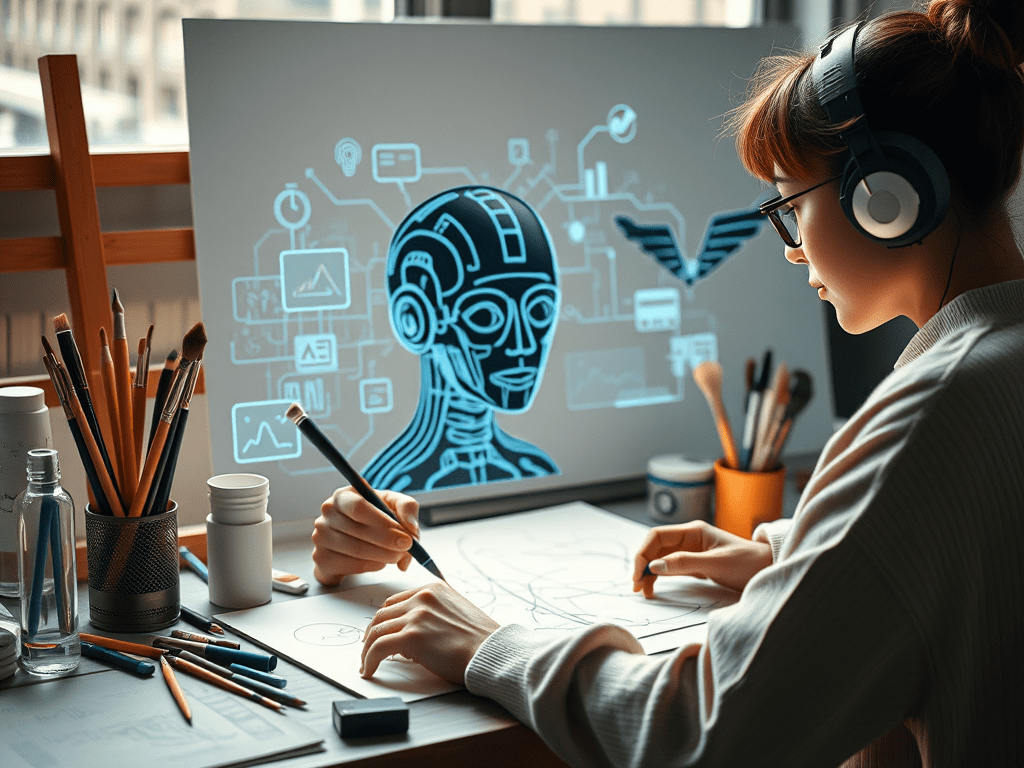
At SundayFringe, we’re always more interested in process than outcome. The same applies here. Share experiments, not polished results. Treat AI like a sketchbook that talks back — sometimes badly. Let it surface patterns you wouldn’t consciously choose, then reclaim them through human storytelling, humour, ethics, and care.
That’s where community matters. AI work becomes richer when it’s discussed, misread together, compared, laughed at, gently challenged. Not “look what I built”, but “look what happened when I tried this”.
Technology as context, not centre-stage
What excites me most about the current moment — whether we’re talking about AI, digital archives, or creative coding — is when technology becomes context rather than centre-stage. When it supports thinking rather than replacing it. When it helps us notice how systems shape us, rather than pretending neutrality.
This is the kind of work that sits beautifully alongside exhibitions, slow-looking spaces, and community-led art platforms. It’s not about speed or optimisation. It’s about reflection. About how tools change us — and how we, in turn, can push back.
In that sense, AI doesn’t replace artistic voice. It gives you something to push against.
And sometimes, pushing back is where the most human work begins.

 Reviews, views & canapés
Leave a comment