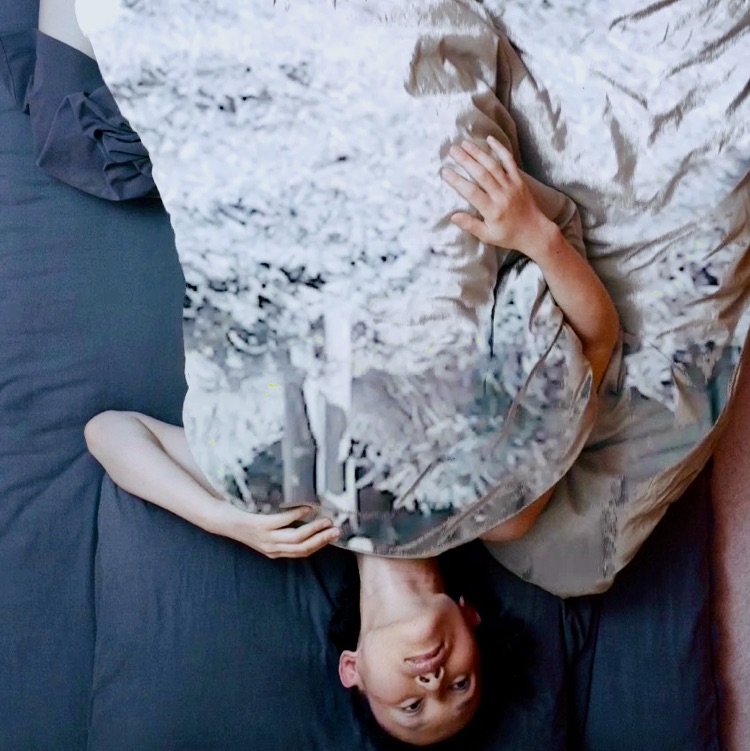
There’s something quietly radical about Hirai-Kikaku and The Fahrenheit Alliance III. Not simply because it was born during Covid isolation, but because it understands adaptation not as compromise, but as a new language of survival.
Built from fragments of recorded voice, movement, relay-performance and visual layering, the work becomes less a conventional narrative and more a living chain of human continuation. One performer reaches toward another. One body carries the rhythm of someone absent. A voice is borrowed, repeated, transformed. The baton passes again. What emerges is not imitation, but accumulation — a choreography of transmission.
Visually, the piece is in constant motion. Physical theatre folds into film language; gesture becomes archive; screens become temporary stages. The movement vocabulary feels restless and adaptive, as though the work itself is searching for new pathways through confinement. Rather than hiding the technological seams, the production turns mediation into part of its emotional grammar. Distance becomes texture.
What makes the project especially compelling from a medical humanities perspective is the way it mirrors forms of distributed care and relational memory that became familiar during the pandemic years. So much of healthcare, grief, friendship and communication moved into mediated forms: recorded messages, remote consultations, fragmented contact, deferred touch. Yet humans continued to improvise rituals of connection. The performance captures that improvisation beautifully.
There is also something deeply recognisable in the structure of “one person carrying another person’s voice.” In medicine and care settings, practitioners often become temporary custodians of another person’s narrative — repeating histories, translating symptoms, preserving fragments of identity between encounters. Here, performance itself becomes an act of holding and transmitting presence.
The adaptation of Kyle Yamada’s original text never feels secondary to the live form. Instead, the production suggests that stories only truly survive by changing shape. The work asks what happens when theatre leaves the room and enters networks, recordings, bodies and repetitions. How much of human communication depends not on perfect presence, but on continuation?
The answer offered here is unexpectedly hopeful.
Even in isolation, people invent new forms of assembly.
Even when separated, movement finds another route.
And perhaps adaptation itself — in art, medicine, memory and survival — is not the loss of an original form, but the proof that something meaningful is still alive enough to evolve.


Leave a comment